Some decisions feel riskier than they should.
This isn’t about the “bet the company” moves. It’s the small, sensible things. Pricing adjustments stall. Hiring takes months. Investment choices circle.
If this sounds familiar, you aren’t managing a crisis. You are managing a friction problem.
Nothing is “wrong,” necessarily. But confidence in making choices doesn’t travel throughout your team.
This hesitation costs you money. In the SME world, slow is a silent tax on your capital.
Let’s be clear about the root cause: The issue isn’t your team’s judgment. The issue is that your rules of decision-making are invisible.
Here is the framework you need to identify those hidden constraints and unlock momentum.
The Fiduciary Risk You Don’t Recognise: Opportunity Cost
The risk isn’t the “wrong” decision. In most SMEs, your team is capable. The genuine fiduciary risk is momentum death.
We’ve seen SME leaders spend 80% of their energy managing risk perception, the fear of a bad outcome, rather than making the actual 20% move that scales the business. When constraints are hidden, your team’s default setting is “safe.” Safe means slow. Slow means you are paying for risk in stalled momentum, even if you never make a bad investment.
A Better Way: A Practical Decision-Making Framework
To move from friction to momentum, you must make the “invisible constraints” visible. The best leaders I know utilize the Reversibility Metric. This isn’t theoretical; it is a direct tool to reduce leadership bottlenecks.
We can categorise every single decision into two types.
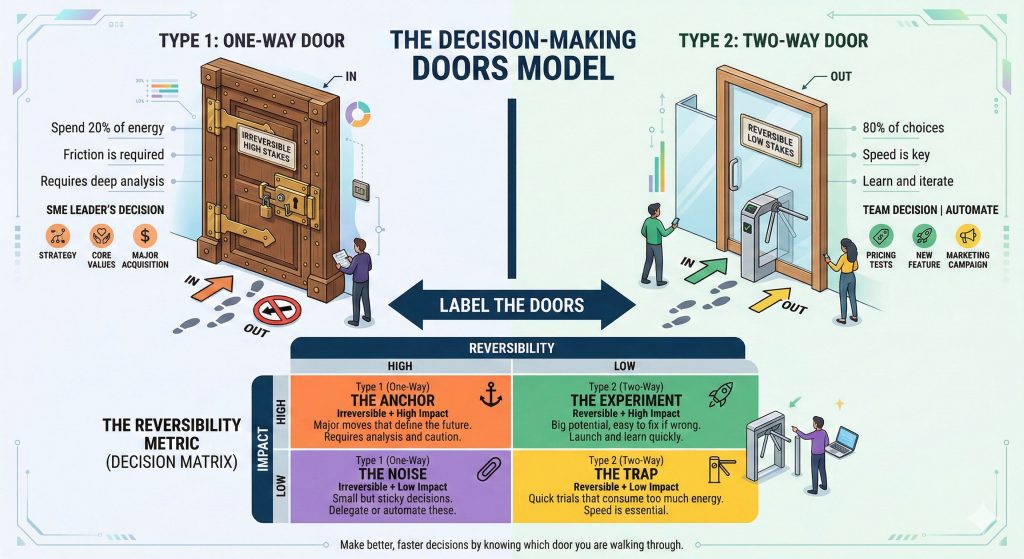
Type 1 Decisions: The One-Way Door (Permanent)
These decisions are irreversible. High stakes. If you walk through this door, you cannot come back.
- Examples: Selling your company, launching a major new product line in a distinct market, signing a 10-year lease, or making a “bet the company” technology bet.
These deserve the friction. These require your deep involvement, patience, and caution. Fewer than 10% of your business decisions are Type 1.
Type 2 Decisions: The Two-Way Door (Reversible)
These are reversible. Low stakes. If the choice doesn’t work, you just walk back through the door. The damage is minor, and the learning is high.
- Examples: Adjusting pricing on a specific service line, hiring a mid-level manager, implementing a new CRM, or testing a new marketing channel.
These should be made quickly. By your team. Not you.
Actionable Key Takeaway: Stop Managing Perception, Start Labelling Doors
The fundamental crisis in most stalled SMEs is that every door looks like a One-Way Door.
If your team is escalating “safe” decisions (Type 2) to you, your management isn’t prudent. It’s broken. You have become the bottleneck. If a decision feels heavier than its actual impact, your constraints are invisible.
Your new job description:
- Identify when a Type 2 decision is stalled.
- Teach the Reversibility Metric to your leadership team.
- Define the minimal constraints required for a Type 2 decision to be made without you.
- Mandate that Type 2 decisions are made within 24 hours.
Your business does not scale when you make all the choices. It scales when you build the system that makes the right choices the fastest.
Need to Unlock More Velocity in Your SME?
We specialise in helping SME business leaders identify hidden friction, build scalable decision-making frameworks, and eliminate growth bottlenecks.
If you are ready to stop being the bottleneck and start scaling your organisation, let’s talk.